
Celebrating 20 Years as Barrington’s Signature Magazine
Standing at the edge of the English Channel in 2011, open water swimmer Doug McConnell turns off all the mental noise to contemplate his swim to Calais, France. He shuts out any negative thoughts to focus on the reality of the feat ahead—cold water, high waves, shipping vessels, jellyfish, and swimming into darkness. With his family by his side in a pilot boat, McConnell sets out to swim across the English Channel, but it’s not, he said, to make himself feel special. For this investment banker, it was all about securing leverage for a cause much greater than himself.
Long-time Barrington resident Doug McConnell grew up in Dundee, Illinois, with two older sisters, Ellen and Martha, and parents Bonnie and David. His parents grew up in Woodstock,
Illinois, where they started dating in high school, and later both attended the University of Illinois.
David, a veterinarian, founded Dundee Animal Hospital, which McConnell says was a family business, where all pitched in and had a great way to bond. His mom was an elementary teacher for a few years and then ran the family’s business operations, running payroll, ordering medical supplies, and using self-taught accounting skills to handle finances. “She was the brains behind the business and really saved the day,” McConnell said.
Home was a normal, ordinary world for the family with one priority standing out. The McConnell children always knew that they would learn how to swim, though their parents did not push competitive swimming.
McConnell’s sister Ellen started swimming in a summer league with the Dundee Township Park District. “I wanted to tag along with her, because she was having so much fun,” he said. “She was an all-around great athlete.”
McConnell started swimming competitively at age 6. “At my first practice, I couldn’t swim the length of the pool,” he said. “I fixed that in a hurry!” After summer ended, there were no indoor pools with many local park districts, so the Elgin YMCA drew kids from several nearby towns.
It wasn’t until he was in his 30s that McConnell learned the reason behind his parents’ motivation that their children would know how to swim. It was the catastrophic death of a little girl in Woodstock, where they lived, who fell into a horse trough trying to fetch her toy and drowned, which shook the couple to their core. The slippery sides of the trough made it impossible for the child to climb out.
After the birth of one of Susan and Doug McConnell’s children, Gordy, veterinarian David McConnell told his adult children that he was diagnosed with ALS, or Lou Gehrig’s disease. As he explained to his family, he would have three to five years to live and would eventually either suffocate or starve to death. He made it clear that this would not be a disease that would run in their family, to reassure everyone.
“He lived for 12 years, which was a mixed blessing,” McConnell said. “On the one hand, our four children got to know him, and I am so grateful for that. They knew what he thought was funny and what he cared about.” McConnell says that the sad part is that they only knew of him in a wheelchair, a once strong man who later could not pick up a fork to eat.
David McConnell died in 2006, and only a few short months later, sister Ellen received the news that she, too, had ALS. While their father made the case that this was not a familial disease in their case, it was. “So, we realized this disease did run in the family,” McConnell said. “We felt helpless and wanted to do something to feel less powerless.”
McConnell swam through his college years and later, at the invitation of a cousin, started training him for the swimming portion of a triathlon, which for some is their weakest segment of the event. “He convinced me to do a swim-only event in Lake in the Hills with the promise of breakfast thrown in. We had a ball, and after this, I started doing open water events.”
Friend and fellow swimmer, Don Macdonald, formerly of Barrington, trained with McConnell locally at a master swimmers club and with small open water swims. He had invited McConnell and wife Susan to their home for a small gathering. “The conversation included a fair amount of wine, and somebody there said, ‘you should swim the English Channel’ which sounded like a crazy idea,” he said. But a few more glasses of wine in, the better the idea sounded, and a seed was planted.
It was Susan McConnell who helped her husband over the first finish line—for him committing to the ‘Mount Everest of open water swims.’ McConnell saw it as a good way to keep training in local open water swims. “Susan said, hey, we can do this, and you really ought to think about it. But I was concerned with the burden it would place on our family. And she said that what I needed was a team, and that she and our four children are that team. It was an absolute stroke of genius,” McConnell said.
An important point that Susan made to her husband is that if he schedules several other open water swims leading up to the English Channel, by the time he gets there, he’ll be past his prime. She encouraged him to get this pedigree first, because if he succeeded, it would set the stage for everything else he wanted to do. “Because when you say you swam the English
Channel, everyone listens,” she said.
With a devoted wife and children who became pilot boat crew, McConnell achieved his English Channel swim as one of about 49 people who made the swim at age 50 or older. It’s a small club. This ultimate endurance test turned a 21-mile stretch into 33 miles as McConnell navigated in a zig-zag pattern at 2.5 mph for 14 hours, stopping every 30 minutes to tread water for a rich nutrient cocktail thrown at him from the boat. One of the greatest risks is hypothermia. But behind every stroke, and every obstacle, was a singular motivator—to gain leverage to support ALS research.
McConnell’s vision is a novel approach to funding a cure for ALS. As an investment banker, he knows how to raise capital and infuse it into companies so they can grow. For ALS research, his strategy has been to invest in early-stage research which can open the door to greater funding, and therefore, has higher long-term impact. Partnering with Dr. Hande Ozdinler, he asks with each round of contributions what is showing the greatest promise in her lab work. It’s a venture capital style of investing with ROI that can open the door to greater funding once research shows promising results.
McConnell set his sights on bringing back a Chicago River swim that ended in 1927. He had heard about a swim in Amsterdam, Netherlands, that also helped fund ALS research. He reached out to the organizers of the Amsterdam City Swim and they were helpful. “I could not have done our swim without them,” McConnell said. “I called to thank them and asked them how they did this time. When they told me they surpassed 50 million Euro, I thought, the pessimist in me would say, our 13-year effort to produce the Chicago River Swim was an opportunity loss of $50M, or the optimist would say, goodness, we are really on to something!”
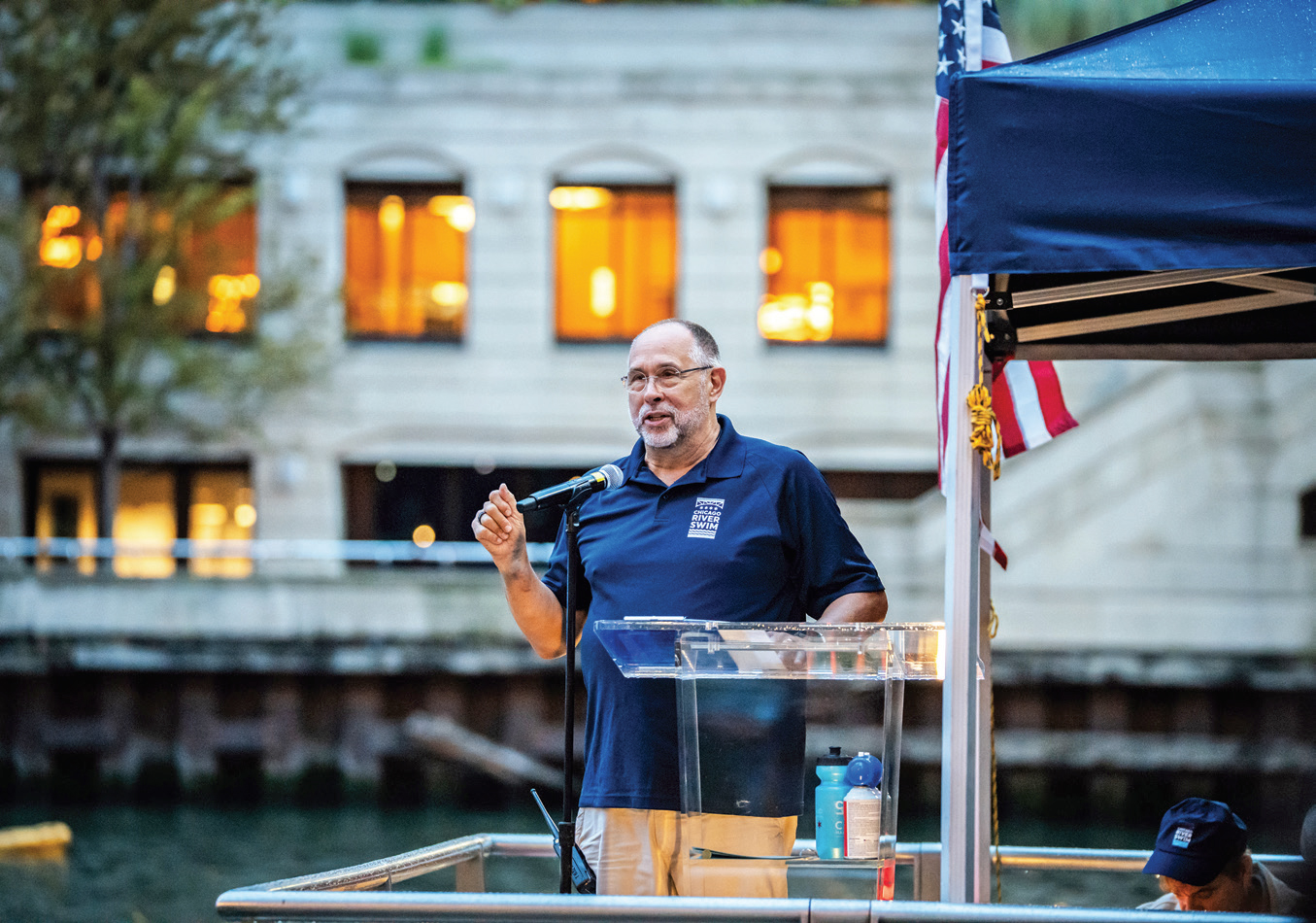
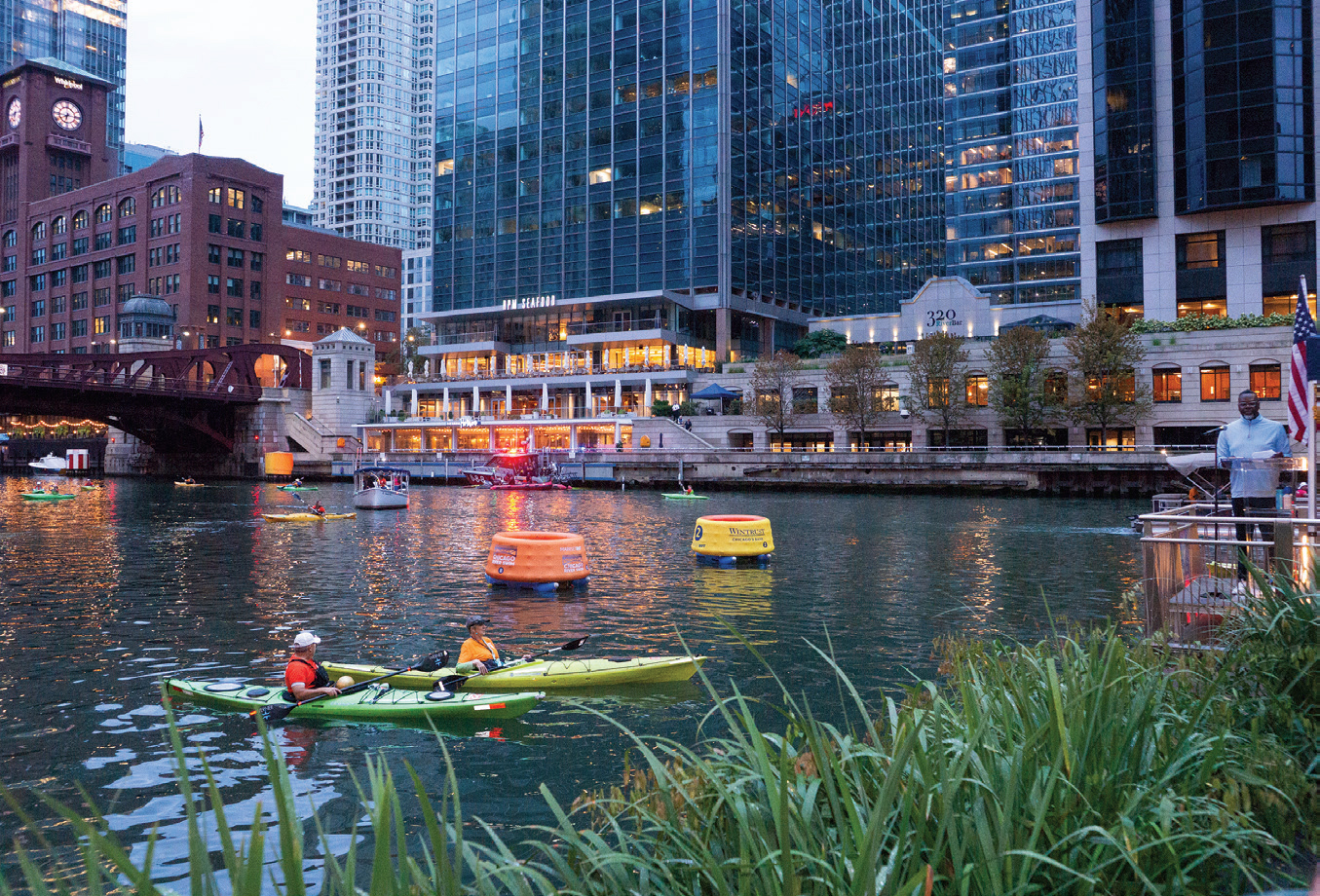
In 2024, the Chicago River Swim had a successful practice run at Ohio Street Beach. This year on September 21, 2025, about 263 athletes from around the world gathered after the City said yes, and the required daily water testing based on Chicago Park District standards conducted by McConnell’s team gave the green light for safe water quality.
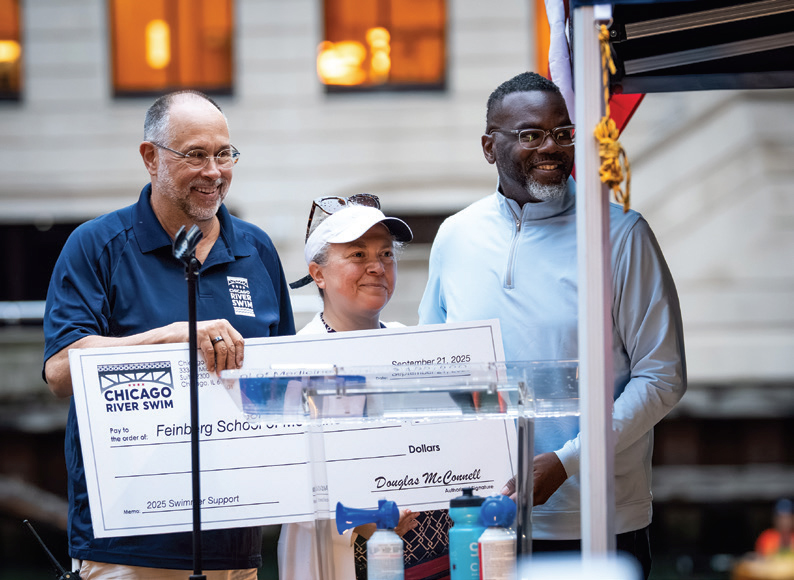
With the success of the event, and a global media splash of three billion views, the organization plans to donate $100,000 to ALS research at Northwestern University’s Feinberg School of Medicine and $50,000 to fund swim lessons for about 2,000 youths at the Salvation Army’s Kroc Center. And the future of the Chicago River Swim looks bright.
Visit alongswim.org to learn more.

Women’s 1-Mile (Non-Wetsuit): Olivia Smoliga (22:45)
Men’s 1-Mile (Non-Wetsuit): Levy Nathan (22:22)
Women’s 2-Mile (Non-Wetsuit): Becca Mann (approx. 40:07)
Men’s 2-Mile (Non-Wetsuit): Isaac Eilmes (approx. 40:13)
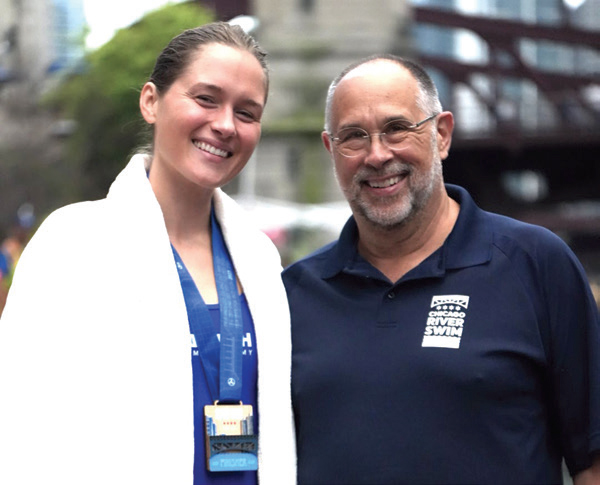
Glenview, Illinois, native Olivia Smoliga is the world record holder for the most gold medals at a single World Aquatics (formerly FINA) Short Course World Championship. Her historic eight gold medals at the 2018 event in Hangzhou, China, broke records previously held by Michael Phelps and Caeleb Dressel. She also won an Olympic gold medal in 2016 in Rio and earned a bronze medal in 2020 in Tokyo.
Smoliga recently founded In Depth Swim Academy, an elite training space for young athletes to learn about wellness, mindset, and performance. Through in-person events, online courses, and conversations, her training supports the whole athlete. We spoke with Smoliga, who won the Chicago River Swim’s Women’s 1-Mile (non-wetsuit) competition, to hear about the experience.
“Doug McConnell attended one of our In Depth Academy events and asked if I’d like to compete in the Chicago River Swim. It sounded insane to me, but I like to try new things! I was curious and thought this was a great way to highlight a city that I love. This swim matters because of the ALS awareness and research, but also because it raises funds for inner city kids to learn how to swim, which is the only sport that is a life-saving skill.
This was my only open water swim. It was so incredible and so elite—walking across the bridge, hearing the intercom announcements, getting our caps and monitors—it reminded me of a world championship event! It got my competitive juices flowing.
The event had a warm vibe. I love Chicagoans. They are so friendly, kind, and hardworking. Swimming in the Chicago River was amazing because it’s not often you can see the city from the river. You feel grounded in nature by the river with this dichotomy of mechanical infrastructure and skyscrapers around you.
Would I do it again? I’d be open to it. But it did make me appreciate my pool and its walls so much.”
Visit indepthswimacademy.com and follow Olivia Smoliga @osmoliga.
The 2025 Chicago River Swim is the trifecta of a visionary swimmer, gifted neurologist, and a major American city
hat cleaned up its river and then said yes
P. Hande Ozdinler, Ph.D is an Associate Professor, Department of Neurology at Northwestern University, Feinberg School of Medicine. We asked her to share progress on her mission to cure ALS.
What are your current research initiatives for ALS?
Since ALS is a disease of both the upper and the lower motor neurons, we focus our attention on the brain component of ALS, where upper motor neurons reside. Since movement starts in the brain, our research is fundamentally important for understanding disease pathology, and for building effective treatment strategies for ALS.
What is the goal in fighting this disease?
Building an effective treatment that overcomes the problems of motor neurons is the ultimate goal. Once we solve the problems of the diseased motor neurons, they will regain their health and become functional. This will lead to improvement in patient’s motor function and ultimately will lead to a cure.
We understand that you have a compound in FDA approvals. What is this compound able to do?
In collaboration with Dr. Silverman, we realized that the compound called NU-9 can improve the health of upper motor neurons that are diseased due to misfolded SOD1 toxicity and TDP-43 pathology, two important problems in ALS. Our IND (investigational new drug) application to FDA has been approved, and we received the OK to initiate clinical trials. The company Akava Therapeutics licensed NU-9 and is now raising funds to complete Phase 1 clinical trials.
Does finding a solution to fighting ALS open the door to fighting other diseases?
Finding solutions to ALS will open the doors to the treatment of other diseases. NU-9 is a great example of that. After we found that it improves the health of motor neurons, there is now evidence that it may help in Alzheimer’s disease. Diseases are more connected than we think and there are many common problems. Once we solve the shared problems, we will bring therapies to many other diseases.
How important is the funding delivered by Doug McConnell’s efforts to your research? How is it applied or prioritized?
A Long Swim is a nonprofit organization raising funds for ALS research, using open water swim to do so. Doug has completed very challenging swims and has raised about $600,000 over the past seven years for our lab, and we are very grateful. Doug is a change maker and a visionary. He brings people together, energizes them to turn ideas into reality. He is a beautifully unique person, making this world a better place each day.
The funding is going to support the Ellen McConnell Blakeman Fellowship (named after Doug’s late sister). This fellowship has been pivotal for initiating new collaborations and for performing key experiments that are important to generate data on novel collaborative projects.
What else should we know about the work you are doing?
The Ozdinler Lab is committed to understanding the basis of neuronal degeneration and developing effective treatment strategies. Our investigations include drug discovery, biomarker discovery, and gene therapy approaches. We tackle the problem from different angles and with different batteries of arms, because it is a big and complex problem.
Share this Story