
Celebrating 21 Years as Barrington’s Signature Magazine

Surviving one-room schoolhouses are a mirror to history. For over a century they’ve served community purposes—education, then religious worship, civic affairs, and social events. Many of the first simple borrow-and-loan banking operations for farmers and stores owners were accounted for in these buildings. Consolidation of these country schools began in the mid-1940s in the Barrington area. Most of them were sold.
In Cuba Township, some were converted into residences. The Bennett, Flint Creek, Honeycutt (Honey Lake), Kelsey, and White Schools still stand, reminding us of our pioneer predecessors. Flint Creek School, rebuilt in 1935 following a fire that destroyed the original school from the mid-1800s and was likely a log cabin, is at the junction of Miller and Kelsey Roads, now a residence for many years.
The home is owned by Michael Johnson and Joanna Krol. Johnson shared this about finding the property. “When my wife, Joanna, and I were house hunting in the Barrington area, we immediately fell in love with the schoolhouse’s charm and history. However, wanting a family and now as parents of boy-girl twins (16 now) we quickly realized the layout and setup wouldn’t be the best long-term fit for our family. My father-in-law George Krol, however, was even more captivated by the place and ended up buying it. We immediately started working on the schoolhouse updating its plumbing, HVAC, and electrical systems, and addressing persistent drainage problems that had built up over decades.”
Like many structures built in the Barrington area in the mid-to-late 19th and early 20th centuries, the wooden frames could not withstand fire. The Flint Creek School was rebuilt in 1935 after a fire, shortly before Barrington country schools would be permanently consolidated. It was rebuilt to stand the test of time.
“The place certainly was charming, and we were particularly struck by its beautifully arched entryway,” said Johnson. “Also, the structure was in good condition. I remember during the initial work my father-in-law, George, and I having to drill into the brickwork and being impressed with the quality and density of the bricks (difficult to drill into even with a modern hammer drill) and the impressive craftsmanship of the mason. The mortar is nearly perfect, and we are just now considering tuckpointing in small areas.

William Powers, a renown American operatic bass-baritone, native of Chicago, and long-time Barrington resident, connected with the Flint Creek School owners just in time.
“Around that same time, we met Bill who was in the process of selling his Frank Lloyd Wright–style home in the Barrington area. We hit it off right away and quickly thought that he and the schoolhouse would be a perfect fit. We ended up renting it to him and he has lived there ever since. Bill has become part of our family (our children called him “Muncle Bill” when they were toddlers!) and he has added his artistic touches throughout.”
If sounds echo through time, Powers hears the same “notes” that students from 1850 would have. The crunching of gravel underfoot on the driveway. Rustling leaves on trees and birdsong. Whistling wind. Wooden walkway boards creaking. The scraping noise of snow shoveled off entry steps.
There are other remnants of yesteryear that pop up in the garden. Powers imagines the placement of hitching posts and has found buried antique horseshoes. Inkbottles reveal themselves in the dirt. Powers has seen deer, squirrels, coyotes, and even a mother turkey with her poults in his yard, the same creatures that crossed the schoolyard in centuries past.
Back in the earliest days of the original Flint Creek Schoolhouse, students would have sung in unison unaccompanied or with the help of a pitch pipe to get in tune. Civic and patriotic songs of the day included “Oh! Susanna” and “Yankee Doodle.”
Just as countryside students learned melodies and lyrics, Powers carries on this schoolhouse tradition over the very same foundation. In his Flint Creek Vocal Studio is a vintage 1910 Steinway & Sons Vertegrand, a historic upright piano model often revered for producing a deep, rich, and warm tone comparable to smaller grand pianos. It is here where students of all ages learn how to sing with Powers’ instruction.
William Powers has performed in New York City at The Metropolitan Opera, in San Francisco, Chicago, and Buenos Aires. He sings in seven languages and has performed in Mexico, England, Australia, France, Germany, and many other countries. His career includes “Camelot” and “Carousel” on Broadway. He was instrumental in directing the career trajectory of Jennifer Larmore, an American mezzo-soprano opera singer who lived in Barrington with Powers when they were a couple.
Powers brings a world of experience and classically trained talent to local audiences at Barrington’s White House and the Sanfilippo Estate for special programs. This Memorial Day, Powers and Organist Dave Wickerham will perform patriotic and great American song selections at the Sanfilippo Estate in Barrington Hills.

When Powers became the renter of the Flint Creek Schoolhouse, it was quite a clean-up project as the property sat unattended for years. “Initially, it was a disaster of neglect; but I must say that a decade and a half of love has made the project something of which I take great pride. The building not only serves as my residence, but as the Flint Creek Vocal Studio where students come to learn a ‘more sound’ vocal technique,” Powers said.
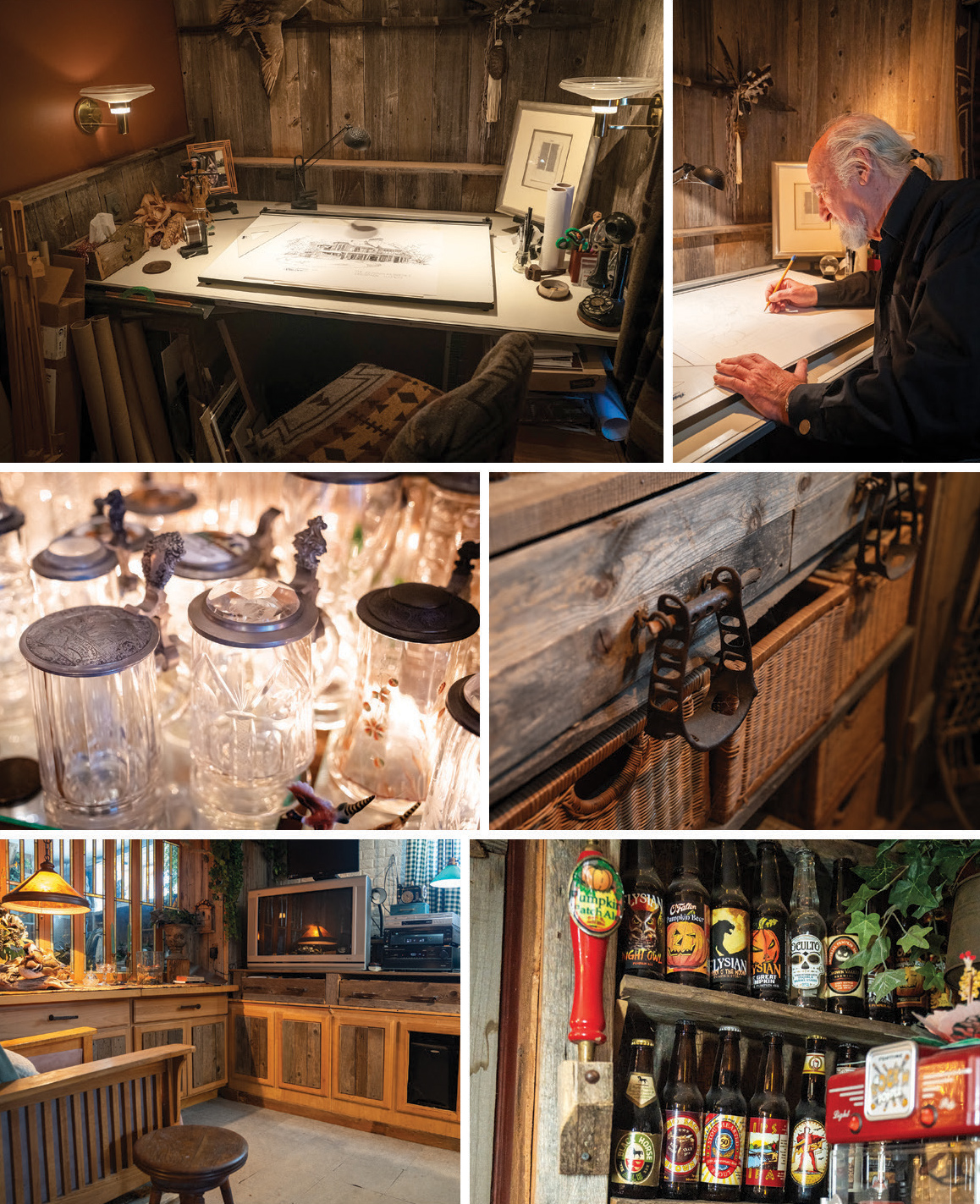
In restoration and decoration, Powers has taken a few design liberties that nod to modernity, such as some retro telephones and a beer bottle collection, but kept the spirit of the 1800s alive using wood paneling, and accents that reflect the early prairie days, as well as some Western motifs. He’s used his skill as a one-time carpenter to make detailed elements like the prairie-style lighting fixtures in the kitchen and picture frames. His drawing studio is a small closet-like space fitted with a drawing table and art supplies. The drawing in the photo (last page) is of the Johnson/Krol home. His pen and ink art is exquisite.
One-room schoolhouses were once the epicenter of the prairie community. Townships in Illinois were charged by the federal government with saving Section 16 of every township’s six-square mile grid, when townships were measured and named, to be used for schools, school buildings, and to finance education. The historic Flint Creek School lives on in the modern era to continue its teaching and to be a place filled with music.
Share this Story