
Celebrating 21 Years as Barrington’s Signature Magazine
When, in 1962, Arnett C. Lines’ “History of Barrington” was published in the Barrington Courier Review, then a broadsheet-sized locally owned and published newspaper, it opened with the following dedication:
“Lest we forget the fortitude, the fearless courage, the determination, the frugal living, the hard work with none of the facilities that are so abundant today, this history has been written as a record of the success of those who left the comforts of civilization in the East and came west to a wild country, and of those who came to America talking a strange language, having very little equipment but bare hands and willing hearts, to wrest from a wilderness or an uncultivated country a living for a large family in a land where they could enjoy freedom from oppression and from pursuit.”
Lines continued: “They came with sons in their teens who grasped the plow of good government, and, having done a masterful work in the Township, came to the new station when the railroad arrived, and repeated their success in the town (village) government and experiences in getting up the country school, by organizing and establishing a new village and its government.”
He followed with words to inspire future generations.
“They builded better than they knew. Today we are enjoying this American heritage. This record may keep the picture before us that we may not take for granted the blessings we enjoy today.”
Arnett C. Lines died in 1970, and his monumental history can be found online at the Barrington Area Library in their local history databases. His work was comprehensive and traced the geographical and governmental history of what would, eventually in 1850, be designated Barrington Township.
There are so many facets to the history of the Barrington area, but since Barrington Township bears the family name, the question remains, who decided that it should be so?
The early days, as the pioneers started to arrive in 1834, have been recalled in previous Quintessential Barrington articles. (See sidebar.)
Realities of the pioneers’ journeys here were grueling in the extreme. Why did so many from the East form the nucleus of township settlement?
The truth was partly that once the Northwest Ordinance was enacted in 1787, the Government surveyors had long since begun their treacherous excursions into the wilderness. Ohio had come first, followed by Indiana, finally being organized in 1800 by Act of Congress. These territories then included the future Illinois. The existence of these future territories in the West was widely promoted in the East.
The Illinois territory, including present-day Wisconsin and the eastern part of Minnesota, was organized in 1809. Illinois was admitted as the 21st State of the Union in 1818, with its capital at Kaskaskia. (Wisconsin was admitted to the Union as the 30th State in 1848 and Minnesota as the 32nd State in 1858.) By then the westward expansion was firmly established.
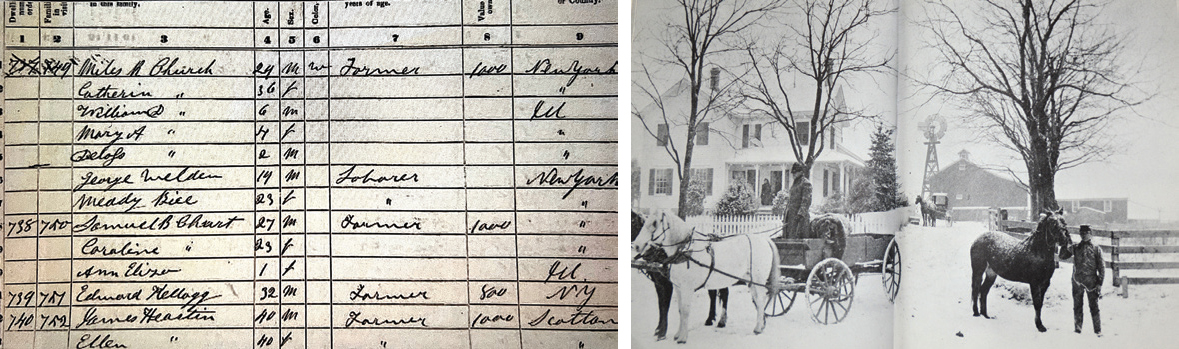
Arnett Lines’ History records that most of the first settlers in the later-named Barrington Township were from New York State and Massachusetts, a few from Vermont, Canada, England, Ireland, and soon Germany. This is confirmed by the 1840 and 1850 Township Census records. From Massachusetts many were from North and South Adams, as recorded by Lines. The Census also confirms that they were mostly farmers, with a few laborers. But so far none have been identified as coming from Great Barrington.
And so, two theories persisted, even with Arnett Lines’ extensive research. One, that those called upon, as Government law required to name and formalize township government in 1850, wanted to call it Adams, and two, that many pioneers from the Berkshire County towns in Massachusetts had met for the journey at Great Barrington, so that was their second choice.
But Adams had a problem. It was already by 1837 the name for Dundee, and two townships in one state cannot have the same name. Double checking Dundee Township and the histories of East and West Dundee, this story can now be refuted. Dundee was always its name, suggested by an early immigrant from Dundee, Scotland.
Furthermore, Illinois’ most western county is Adams, with Quincy as its county seat, and a small, unincorporated community in the county is called Adams. In addition, Adams Township is in LaSalle County, and they were all settlements earlier than our Northern Illinois counties.
As for Great Barrington as the second choice, and no discernible clues, it was informative, and a pleasure to be in contact with Bernard Drew, historian and feature writer for the Berkshire Eagle who lives in Great Barrington, Massachusetts. From him it was learned that Adams had already, in the early 19th century, become an industrial town of textile and paper mills. At the foot of the Berkshires, industrialization impacted on the available arable land.
Great Barrington, however, on the Housatonic River, became the gateway to the recreational and cultural activities that the Berkshires are famed for. By the early 20th century, it had become a resort town for those seeking respite from the industrial cities of the state, not unlike Barrington, Illinois, was for Chicagoans. Of its earlier history as a gathering place for the westward bound pioneers, Bernard Drew could not confirm this.
Whatever their departure point, the pioneers of the 1830s and 1840s were leaving behind established communities, farms, and businesses. Some as noted by Arnett C. Lines had civic experience. Behind them, for the older ones’ recent memories, were the battle grounds of the Revolutionary War. For a few, in their youth, George Washington was president, to be succeeded in 1797 by John Adams.
For most, their destination first was the Town of Chicago, then still a settlement mired in mud with a few houses, taverns, and a post office. Chippewa and Ottawa dotted the surrounding countryside and their trails led into the wilderness. Du Sable, Kinzie, and Beaubien were among the historical names of this place, as were Billy Caldwell the “Sauganash” and Alexander Robinson, “Che-che-pin-quay.
A letter from Francis Hollister Kelsey, early among the pioneers of Cuba Township, was later transcribed to give an account as the family emigrated from New York State to Illinois by wagon train:
They departed Saturday July 20, 1842. He (Francis Kelsey) reported the weather as being fine: the routes good; and as having made the journey without misfortune except for the third day. They stayed close to Erie [on] July 22 “in the Ohio.” Wealthy, Diantha, and Angeline had been walking. Defores fell from the wagon and the hind wheel ran over his breast. They took him from the wagon to a doctor in the next village, about a mile down the road, where he was bled. They stayed until the next stage arrived and then went on. They arrived at Tesumpa (Tecumseh, Michigan) August 5th and stayed with Alonso Williams, leaving there on the 8th. On the 20th day, August 9th, they arrived at Chicago. There they found their household goods safe having been shipped by water.
The next part of the letter describes perhaps the greatest peril that faced the travelers to the west—illness and accidents:
They proceeded west across the Des Plaines River and were reported as being in good health. Soon, however, they became ill with ague and fever. The mother of Francis Hollister Kelsey, although having made the journey well, became sick September 7. In another transcription of the letter, it is recorded that Francis Kelsey’s mother died on the 10th of September 1842.
Many children and the elderly died from what doctors often referred to as bilious. Most gravesites were not in established cemeteries. Infant and childhood deaths were a fact of pioneer life. Over 40 infant and childhood deaths in pioneer families are recorded on headstones in Barrington Center Cemetery founded in 1834.
But there was survival, too. When the 1850 Census is read which lists place of birth for heads of household, and children, it records that there were births on the journey west, probably in the back of Conestoga wagons.
The final surveyors map for Township 42 North, Range 9 east, Third Principal Meridian was recorded in the Surveyors Office in St. Louis in 1838, but it was not until 1840 that the pioneers could obtain deeds for the land they had staked and claimed.
From Chicago they ventured out, following native trails to the west, north, and northwest. To the northwest they had to ford the Des Plaines River. Here there was a clearer route, the Army trail that wound its way to Fort Winnebago in Wisconsin, and described by Mrs. Juliette McGill Kinzie, wife of the Government Agent, John Harris Kinzie, Jr. to the Winnebago. Her book “Waubun,” or “The Early Day in the Northwest,” recounts their journey in 1831 to Kinzie’s post and the hazards of journeying from Chicago to Fort Winnebago at that time.
It was long recorded that Jesse F. Miller and William van Orsdal were the first to settle in the [Barrington]Township in 1834, building a log cabin in Section 16 on the Spring Creek. Historical accounts suggest that there were still Potawatomi in the area at this time. Miller and van Orsdal had come from Steuben County, New York. A few years ago, the McHenry County Historical Society confirmed that in 1834, the Gillilan family, traveling from Virginia to Algonquin Township, stopped overnight at the log cabin of Jesse Miller and his wife Ruth Klink Miller. The next morning, the Gillilans forded the river to Algonquin and became the first white people to settle there. Later, the Millers moved over the river, and from 1856–1858 Jesse Miller was supervisor of Algonquin Township.
Both Miller and van Orsdal had moved to Section 17 when Section 16 was designated for the school district as required. Their names do not appear on the 1851 Rees map, by which time the township was named Barrington, with the population shown on the map as 672.
Where the Algonquin and Dundee trails converged there was a coaching and mail stop with a blacksmith shop and general store. That was known as “Barrington Center,” referred to by old timers of the township as “the center.” The first Post Office in the Township was at the house of Alvah Miller, which was at the northwest corner of Route 62 and Sutton Road. Miller was postmaster there from February 1845 to June 1849. The bones of the house are still there, but it has undergone many renovations.
In the 16 years since 1834, their lives had centered around the school, where meetings and church services, first conducted by horseback traveling preachers known as Circuit Riders, were held. Dundee was their main commercial destination.
April 2, 1850, marked the day that the ancient name of Barrington, after centuries of survival in England, and having been transplanted across the Atlantic to the New World, where both Rhode Island and Massachusetts claimed its distinction, would, by what messenger we are still not certain, be signed into law, giving its name to first, in Cook County a Township, and soon a Village, and then, in the mid-20th century to five surrounding villages: In Barrington Township to Barrington Hills and South Barrington, and in Lake County, Cuba Township to North Barrington, Lake Barrington and later Port Barrington.
The opening words in the beautifully scripted Barrington Township Minutes Book confirm the future:
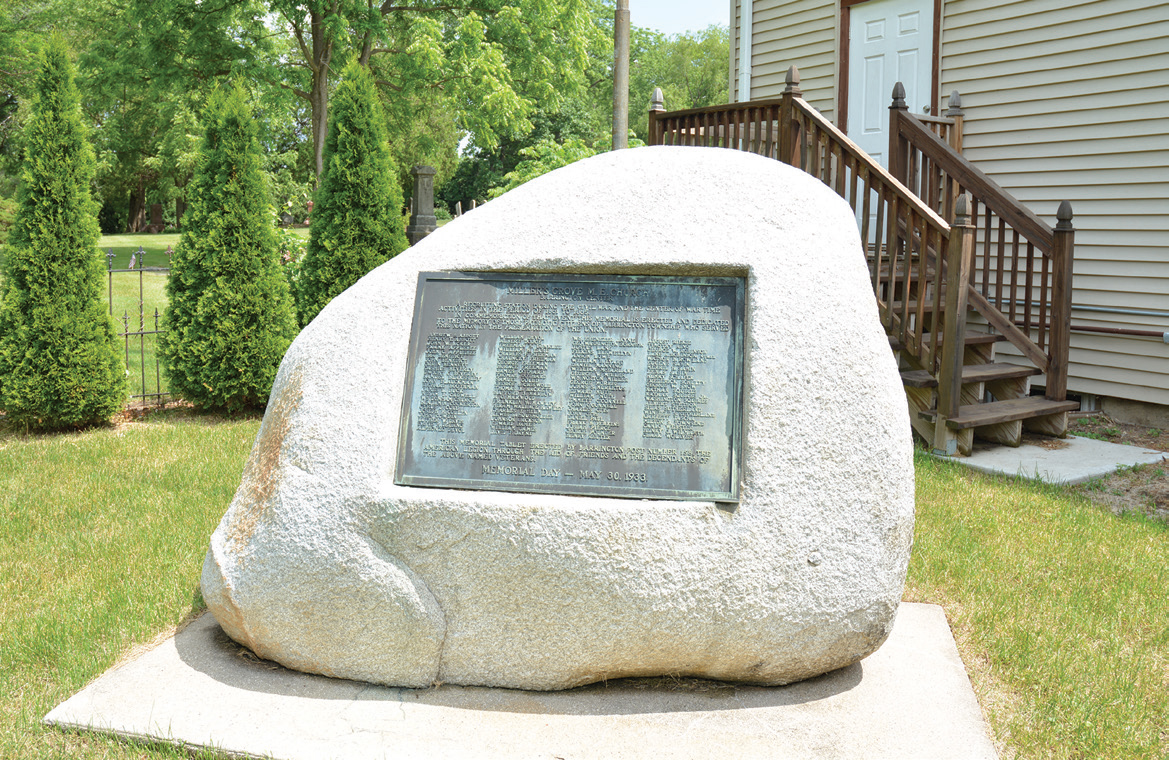
In accordance with an Act of the Legislature of the State of Illinois approved February the tenth in the year one thousand eight hundred and forty-nine an Act to provide for Townships in the State of Illinois and agreeable… A Notice previously posted up by the Sheriff of the County of Cook the inhabitants of the Town of Barrington in the County of Cook and State of Illinois met at the school house at the south end of Millers Grove on Tuesday the Second day of April one thousand eight hundred and fifty for the purpose of holding their first Town Meeting and in being called to Order made choice of William Adams as Moderator and Jerome W. Kingsley as Clerk for the day and then proceeded to cast their votes for the several various officers for the coming year.
On canvassing the votes cast, the following were elected:
William DeVoll: Supervisor
Alvah Miller: Town Clerk
Edward Hawley: Assessor
Homer Willmarth and William DeVoll: Justices of the Peace
William Hitchcock and Aaron Billings: Constables
Graves Ward: Collector
Hezekiah Kingsley: Overseer of the Poor
These were the first elected Township officials, and they are not lost to history because they are buried in historic Barrington Center Cemetery, their gravestones to be read and contemplated for generations to come.
So many early residents are buried there, their families recorded in the 1850 Barrington Township Census. There are some who were born in the 18th century around the time of the Declaration of Independence and
arrived here in middle age. Some served in the War of 1812, and more poignantly, as recorded by headstones, some 42 infants and young children. A few headstones record the passing of a mother and infant within days of each other.
A few would have descendants still here, generations removed from Hawleys, Kingsleys, Millers, and Watermans, but most scattered out across the country. If any should read this, and realize that they are descended from these pioneers, perhaps be in touch with Barrington Township.
Some words of inspiration come from an unlikely source, but remember, his mother Jennie Jerome was American. In an address to the Canadian Parliament in World War II, Sir Winston Churchill said: “We have not journeyed all this way across the centuries, across the oceans, across the mountains, across the prairies, because we are made of sugar candy.”
Not sugar candy, but hope and faith in the Lord, for the blessings that this prairieland would bring them. To Barrington Township, and our family name, this is the beginning of your story.
For more and later history of Barrington Township, read “Barrington Hills, A Look at Yesterday, Today, and Tomorrow,” which appeared in the Jan/Feb 2021 issue of Quintessential Barrington. Also see the history of the Barrington United Methodist Church, “A Circle of Faith,” in the May/June 2024 issue of Quintessential Barrington. For a remarkable history of the Barrington name, read John J. Curry Jr.’s article, “A History of the Barrington Name,” run in the July/August 2020 issue, and found online under the “All the Barringtons in the World” tab at qbarrington.com.
Arnett C. Lines (1882-1970) spent much of his life documenting the history of his pioneer ancestors. Historians of the Barrington area stand humbly on his shoulders. Since in 1980, coming to Barrington, and being among those who have taken up Arnett’s pen, for now only half of my life, I have been joined and encouraged by some who knew Arnett, like Ruth Munson, William Klingenberg, Jr., George Van Hagen III, and other “old timers.”
Later there was Ken Munson, (Ruth’s son, steeped in Barrington history and genealogy) Mrs. Julia Rock, tireless seeker of the facts and truth, especially in Cuba Township, and Tim Dunn, nephew of Arnett. Also pursuing her publishing of biographical Barrington histories was Diane Kostick who authored “Voices of Barrington” and Chronicles of Barrington, Illinois.”
Stewarding my published body of works through 45 years now have been editors at the Barrington Courier Review, the Board of BADC by publishing my book “They Builded Better Than They Knew;” in Cuba Township where I live, former Supervisor David Nelson, and present Supervisor Christopher Karam, for “historical” space in the Township newsletters. The Barrington Area Library, especially, first Nancy Allen, then Rose Faber, and until recently Kate Mills, who has provided some of the most important information to continue documenting the early history of Barrington Township and the area and to the library for maintaining a remarkable historical photograph collection online. These librarians have always been ready to help with research.
To Barrington’s White House, for opportunities to share history programs with audiences from time to time. And to Jacqueline Stephens and Patrice Miller at the Barrington Township office who carefully brought out the treasure that is the Barrington Township Minutes Book.
Heartfelt thanks to Bernard Drew, historian and writer in Great Barrington, Massachusetts. Donna and Bernard Drew were gracious hosts and historians for Lisa Stamos when she visited Great Barrington in 2014 for the Sesquicentennial Edition of the QB published in 2015. We hope you are proud of your namesakes.
And, for the last 10 years or so, founder, publisher, and editor of Quintessential Barrington magazine, Lisa Stamos. While publishing a magazine that documents facets of contemporary life in Barrington, she has devoted hundreds of pages to the ongoing story of our villages and townships, and the people, past and present, who make their history.
My journey has been gratefully shared with so many, and I think they would agree, that when in doubt about those earlier days, we will always circle back to Arnett C. Lines.
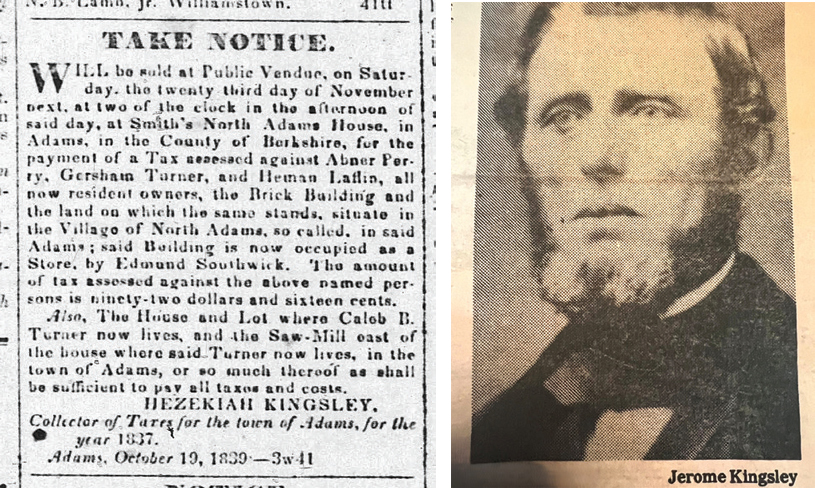
Hezekiah Kingsley was born in North Adams in 1794. He and his wife, Joanna Wells Kingsley, moved from Adams in the County of Berkshire, Massachusetts, to Barrington Township, Illinois, in 1840.
Like other pioneers who moved from the East to the prairies of Northern Illinois, Hezekiah Kingsley brought local government expertise that contributed to Barrington and influenced his son, Jerome, who became a major civic leader in the village.
Hezekiah served as the Collector of Taxes for the Town of Adams in 1837 as seen in this newspaper clipping, “Take Notice,” listing a few buildings, owners, and taxes due. His first leadership role in Barrington Township was Overseer of the Poor in 1850.
Joanna and Hezekiah Kingsley had a son, Jerome W., who was born in 1821 in North Adams, Massachusetts. He migrated West with his parents, who are both buried alongside other family pioneers at the historic Barrington Center Cemetery. Jerome heavily shaped the early government, infrastructure, and development of Barrington Township.
Jerome Kingsley served as a local postmaster along the historic Chicago-to-Freeport stagecoach and mail route (running through early Barrington Center) in the mid-1850s. Family members were also foundational in early local civic organizations and education efforts, such as the mid-19th-century Barrington Academy. In February 1865, the State Legislature appointed Kingsley as a founding corporate body member to establish and maintain the Barrington Academy, a high-trade institution of learning capitalized at $100,000.
When the Chicago and Northwestern Railway shifted the population toward “Barrington Station,” Kingsley moved into the new village and took up leadership roles in early government. He served as Village Board President in 1886. Jerome Kingsley lived out his later years as an influential senior settler and passed away in Barrington in 1906 at age 84.
Editor’s note: Thank you to Historian Bernard Drew in Great Barrington, Massachusetts, and the Barrington Area Library for sharing their many historical resources.

Barrington Township Supervisor, D. Robert Alberding, serves as the chief executive officer of the Township, which includes serving as chairman of the Township Board of Trustees and serving as treasurer of all township funds.
Townships are the oldest form of local government in the United States, preceding even the established of counties and municipalities. Barrington Township was founded in 1850 to serve a geographic area of approximately 64 square miles that currently overlaps several municipalities. Our elected officials play a vital role in local governance, influencing community services like road maintenance, public assistance programs, and property assessment assistance that directly impact resident’s lives. Their responsibilities are crucial for the support of essential services and infrastructure needs depended upon by our residents.
Barrington Township delivers a broad range of community services that directly support our residents’ everyday needs. From property assessments and road maintenance to transportation, youth and senior programs, Food Pantry assistance, open space preservation, and cemetery maintenance, these services
enhance the quality of life across our communities and unincorporated areas.
Barrington Township is uniquely positioned to respond to local needs, offering a responsive and accessible form of government that
remains connected to the people. Without Township involvement, many seniors and general assistance recipients, particularly those on fixed incomes, would fall through the cracks due to complexities experienced while navigating through the vast support system requirements.
In this way, township government remains a frontline provider of care and support.
Going forward, Barrington Township is committed to providing its residents with a frontline approach to local community needs.
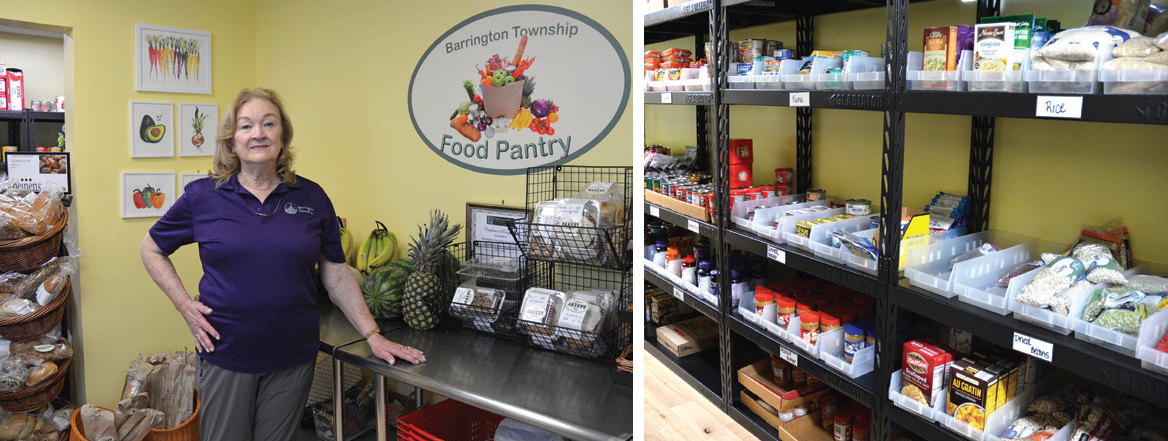
The Barrington Township Food pantry is registered as a 501(c)3 and is funded and stocked completely by private donations. Every Monday, one of these churches, Community Church of Barrington, St. Mark’s Episcopal Church, or St. Michael’s Episcopal Church, rotates to help stock the shelves and bins at the Food Pantry. Quarterly, the Presbyterian Church of Barrington provides funds. During the holidays, Barrington Police and Fire personnel provide a large donation. Advocate Good Shepherd’s Smart Farm is a source of fresh produce in season, and Heinen’s and Panera Bread provide baked goods. Jewel donates meat and other frozen items, and the Community Meal also participates with shared resources.
Food Pantry guests are called “shoppers” who are offered 30 minutes to gather what they need and scheduled one at a time as a courtesy. “Our shoppers are between 50 and 60, senior citizens, and some families,” Food Pantry Coordinator Patrice Miller said. “We also provide personal care products and other household items not covered under SNAP benefits.”
There is little-to-no waste, Miller says, of unused items at Barrington Township Food Pantry. Any leftovers are donated to St. Joseph Home for the Elderly or a shelter.
by Jim Vanderpoel
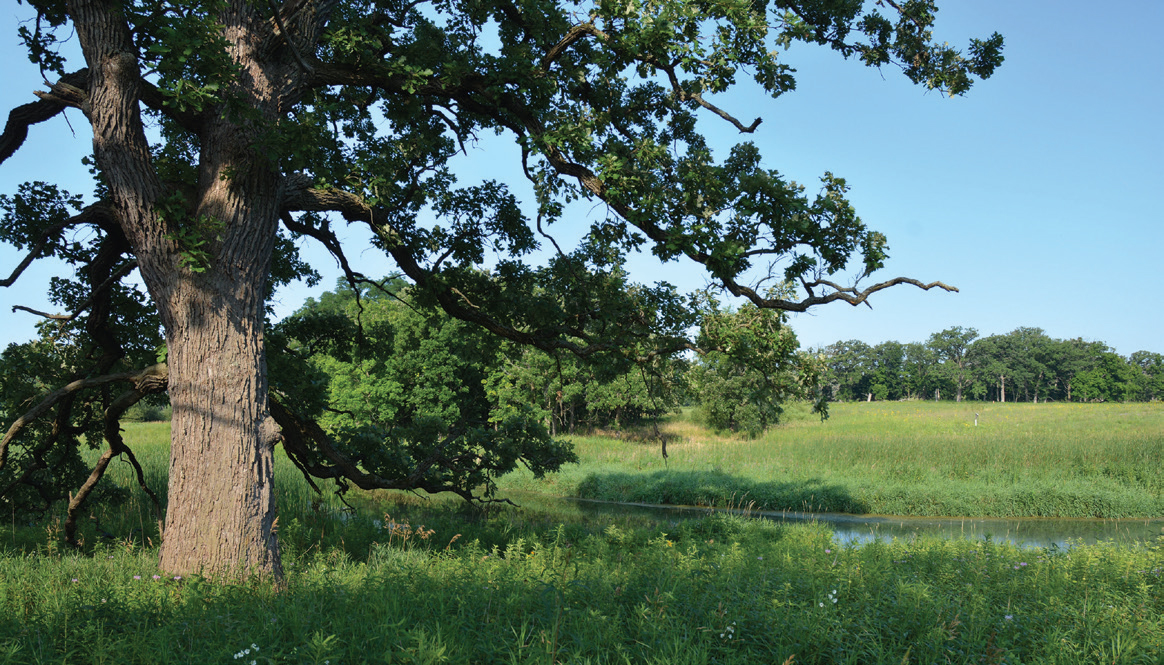
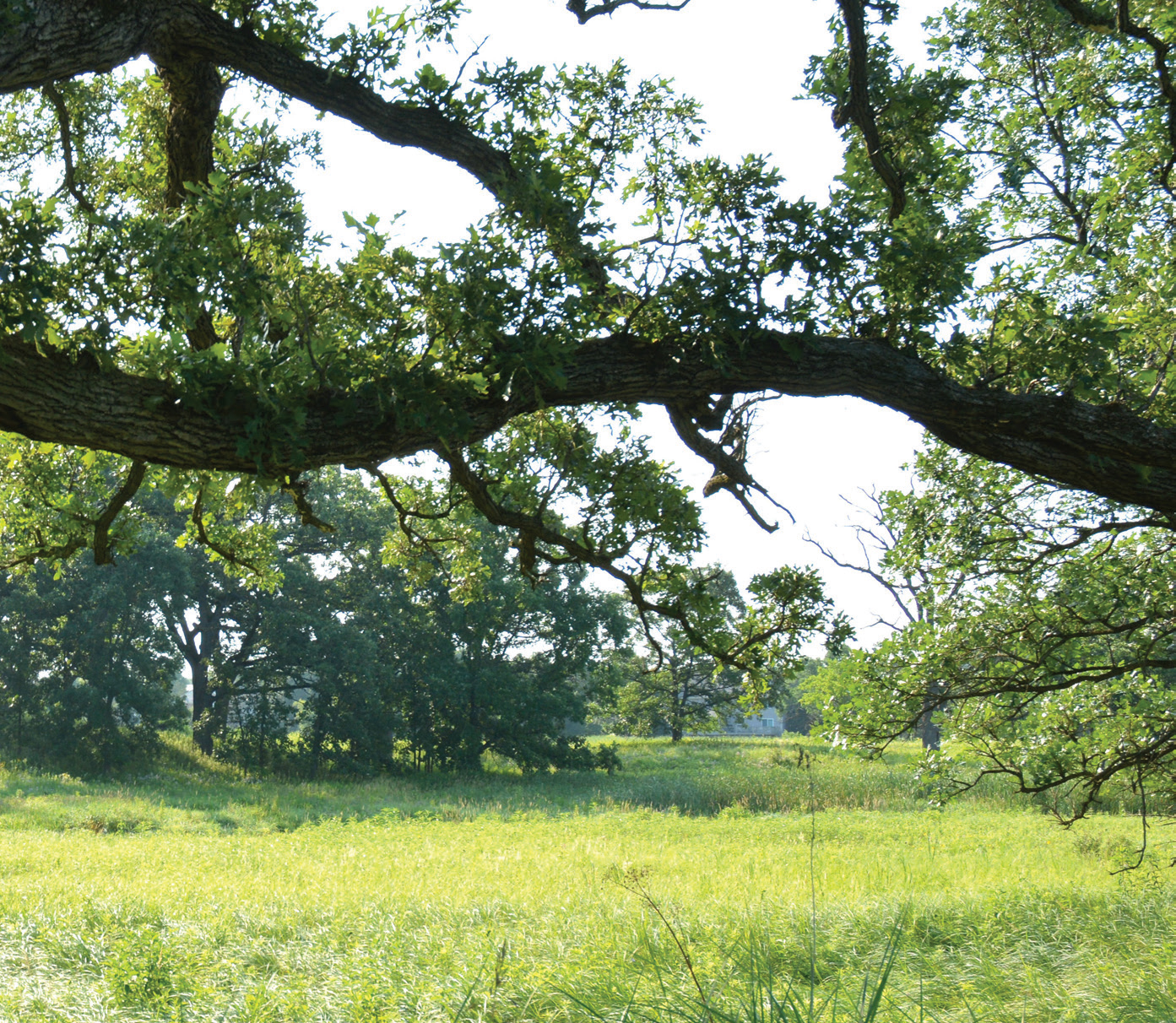
Barrington Township’s ancient oak groves gave early settlers shelter, resources, and a place to begin.
The name of the pictured site above is Original Grove, a feature within Flint Creek Savanna Preserve, which is owned by Citizens for Conservation (CFC). It is an ancient grove with many oaks from 200 to 300 years of age. Most of the trees are bur or white oaks, but there are scattered red and Hill’s oaks, black walnuts, black cherries, red cedar, and silver maples, giving the small woods some surprising diversity.
Most of the understory was destroyed by heavy overgrazing, but CFC is restoring the health of the grove by improving the soil and reintroducing the understory plant community, which has led to beautiful wildflower displays and improved oak regeneration. The improved habitat has attracted birds like wild turkey, red-headed woodpeckers, and great horned owls; mammals like eastern fox squirrel, meadow jumping mouse, and American mink; and butterflies like banded hairstreak and northern pearly-eye.
American settlers believed that prairie was un-productive for growing crops—this belief was soon proven incorrect and settlers started large scale agriculture on the prairie using John Deere’s innovative self-scouring steel-bladed plow. Settlers still liked to build near the groves because the groves gave some protection from wildfires and supplied timber for building material and firewood. Settlers also hunted wildlife like elk, bison, white-tailed deer, and wild turkey, all of which frequent the edge of grove and prairie.
Prairie groves typically formed on land that was protected from frequent fires. Original Grove occupies a bluff on the east bank of Flint Creek; presumably wildfires were driven by the prevailing westerly winds and would go out on the leeward bank of a stream and would be reignited further east by wind borne embers. The oak woods, tall grass prairie mosaic developed around six thousand years ago during the xerothermic period after the melting of the last great Pleistocene ice sheet. Most of the prairie groves were severely disturbed, but one can still see old trees in historic places like Long Grove, Deer Grove, Elk Grove, Plum Grove, and Sarah’s Grove (renamed Schaumburg).
Jim Vanderpoel is a long-term board member and restoration volunteer of 39 years with Citizens for Conservation. Quintessential Barrington thanks Mr. Vanderpoel for his work on behalf of CFC, and for a guided tour of the remarkable Original Grove in Barrington, Illinois for this article.
Share this Story